 Est. 2003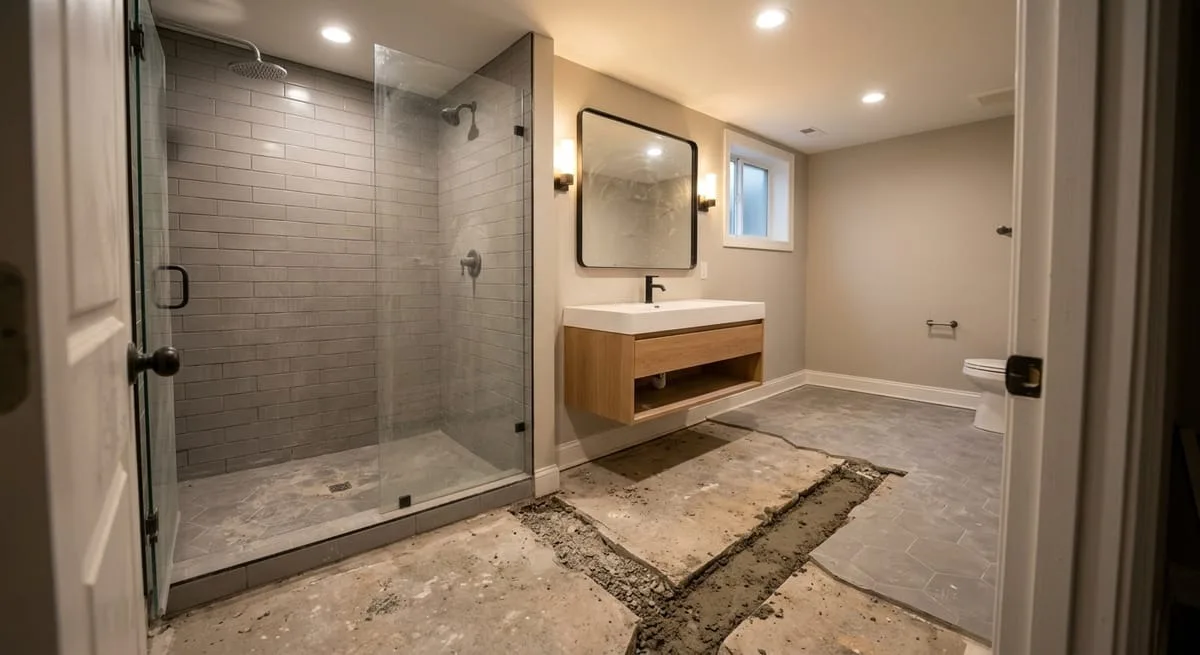
Planning a remodel means tracking your expected basement bathroom cost before the first hammer swings. Adding a bathroom to your basement is one of the most practical upgrades a North Atlanta homeowner can make, and one of the most misunderstood when it comes to pricing. This guide covers what basement bathroom addition projects actually cost in Cherokee, Cobb, and Fulton County, why the price range is so wide, and how to figure out which path makes sense for your specific basement.
How Much Does a Basement Bathroom Cost in Atlanta?
Most North Atlanta homeowners pay between $3,000 and $25,000 to add a bathroom in a basement, with luxury finishes pushing past $40,000. That range exists because two basements are almost never the same. Existing plumbing, slab condition, and bathroom type all move the number significantly.
| Bathroom Type | Atlanta Market Range |
|---|---|
| Half Bath / Powder Room | $3,000 – $8,000 |
| ¾ Bath (Shower, No Tub) | $8,000 – $15,000 |
| Full Basement Bathroom | $10,000 – $25,000+ |
| Custom / Luxury Finish | $20,000 – $40,000+ |
| Add for Concrete Cutting | $2,000 – $6,000 |
| Upflush System (Alternative) | $4,000 – $9,000 |
These reflect actual labor and permit rates in Cherokee, Cobb, and Fulton County, not national averages, which run 15–25% lower than what contractors in this market charge.
The single biggest variable is whether your basement already has rough-in plumbing stubbed in. If the builder left drain lines in place during original construction, your project stays at the lower end of the range. Without rough-in, you’re looking at either concrete cutting or an upflush system, both covered below.
Planning a full basement finishing project alongside the bathroom? The basement finishing cost guide for Atlanta breaks down per-square-foot costs and common budget line items for the broader project.
Do You Need to Break Concrete? How to Choose the Right Approach
Path A: Existing Rough-In Present (Lowest Cost)
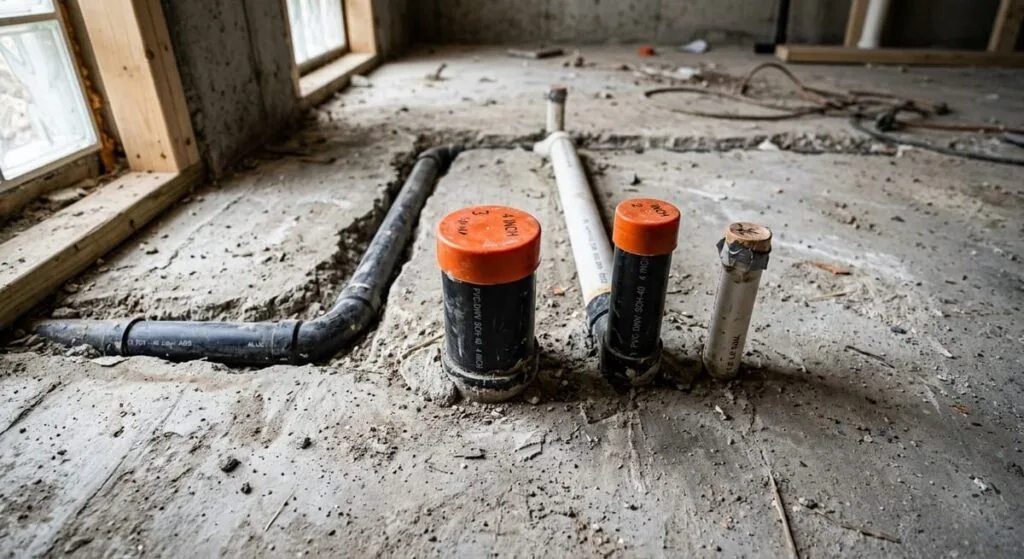
Some builders stub out drain lines during original construction. If yours did, you have capped pipes waiting in the slab. You still need to connect supply lines, install fixtures, frame the bathroom, add ventilation, and run GFCI-protected electrical, but you skip the most expensive step of the entire project.
Path B: No Rough-In, Unfinished Slab (Concrete Cutting Required)
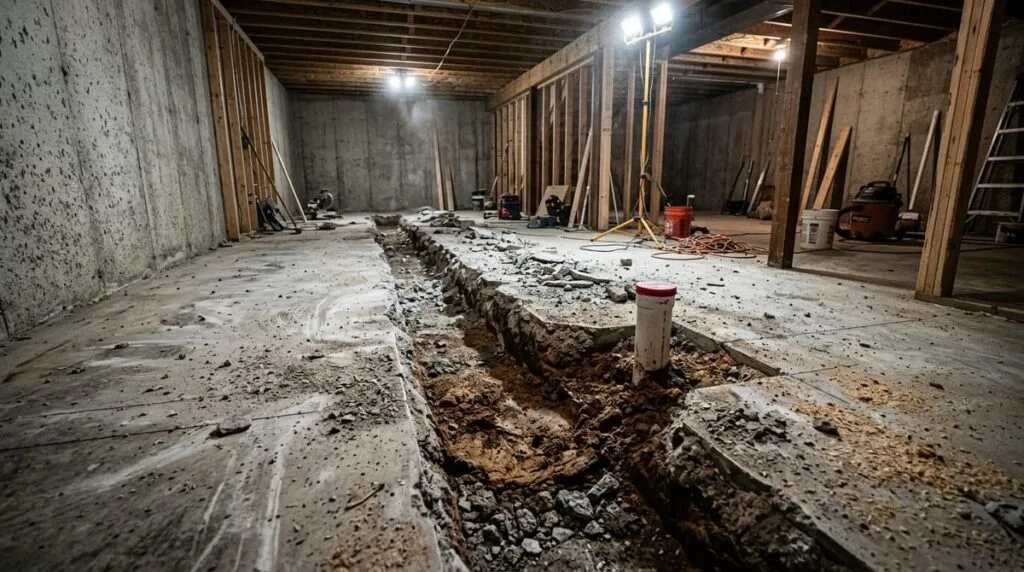
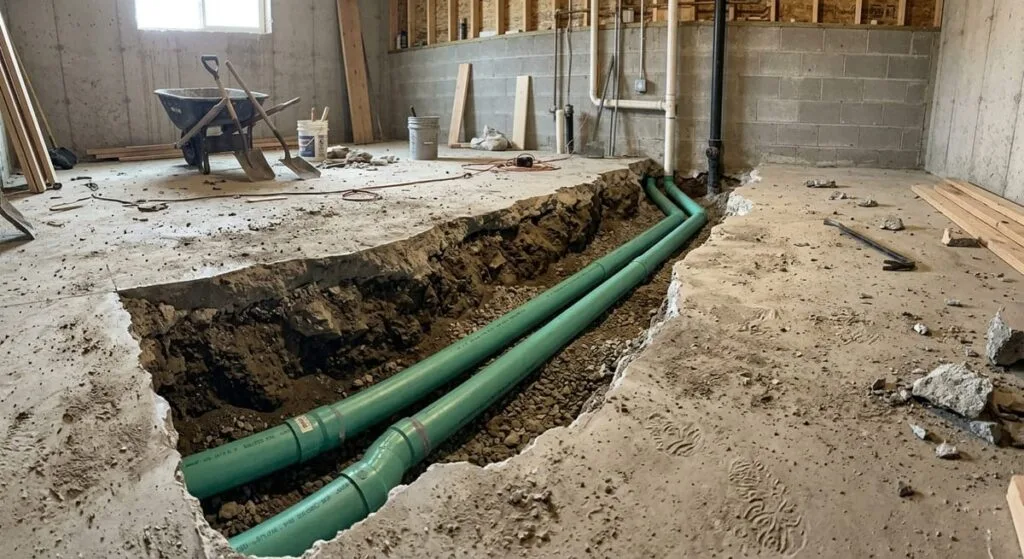
Without existing plumbing, concrete cutting is required. This involves saw-cutting a trench, installing new drain pipe pitched at the Georgia-required minimum ¼-inch-per-foot slope, and re-pouring the concrete once inspected. Add $2,000–$6,000 to your base cost. The result is a conventional gravity-fed bathroom identical to any above-grade floor.
Path C: Finished Slab or Difficult Drain Access
If your slab is already finished or accessing it would require tearing up finished flooring, an upflush system is often the smarter alternative.
Not sure which path applies to your basement? Artistic Construction offers a free walkthrough to assess your slab condition. Request a free estimate and we’ll tell you exactly where you stand.
Upflush Toilet vs. Traditional Rough-In for Atlanta Basements
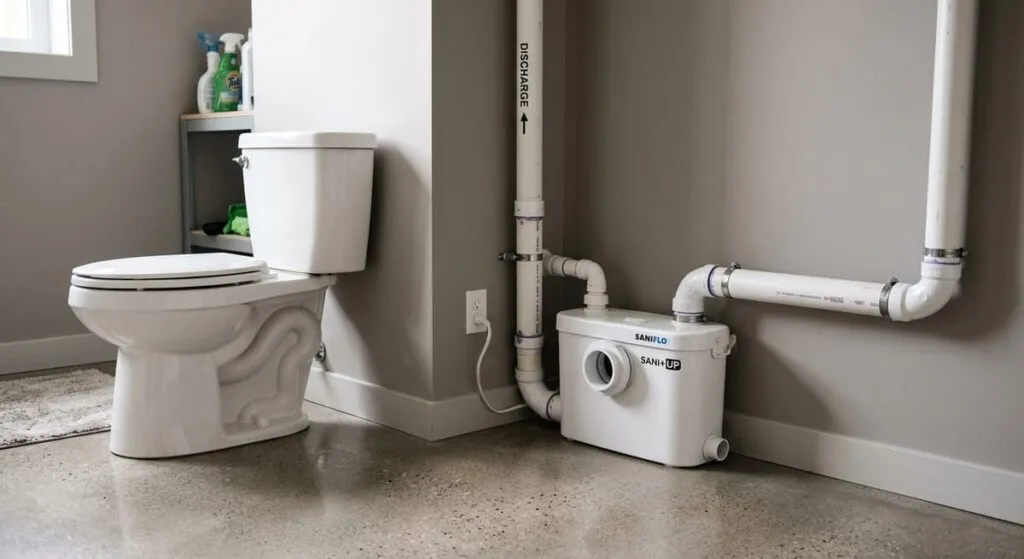
A conventional toilet relies on gravity: waste flows down through the slab into drain lines below. An upflush system (most commonly Saniflo brand) grinds waste and pushes it upward through a small-diameter pipe to connect with existing drain lines above the slab. No concrete cutting. No trench. No re-pour.
Upflush toilet basement cost runs $4,000–$9,000 installed, making it a competitive alternative when concrete cutting would otherwise be required. Most residential units pump vertically up to 15 feet and horizontally up to 150 feet. Installation takes one to two days versus four or more for traditional rough-in with concrete cutting.
| Factor | Upflush System | Traditional Rough-In |
|---|---|---|
| Installed Cost | $4,000 – $9,000 | $6,000 – $15,000+ |
| Concrete Work Required | None | Yes, if no existing rough-in |
| Installation Timeline | 1–2 days | 4–7 days |
| Maintenance Required | Periodic pump service | Standard plumbing only |
| Resale Perception | Mixed | Universally understood |
| Best Use Case | Guest/secondary bath | Primary daily use |
Artistic Construction recommends upflush when the slab is finished or costly to cut and the bathroom will function as a guest bath. We recommend traditional rough-in when you plan to sell within two to three years or the bathroom will see heavy daily use. If resale is your primary motivation, traditional rough-in is the safer choice even if it costs more upfront.
Full Basement Bathroom Cost Breakdown: What Each Dollar Pays For
Labor Costs in Atlanta ($45–$85/Hour)
North Atlanta labor rates run higher than national averages. A licensed plumber in Cherokee or Cobb County runs $65–$85/hour. General construction labor runs $45–$65/hour. A standard basement bathroom involves 40–80 labor hours depending on scope. Electrical is a separate line item, GFCI-protected receptacles and a dedicated ventilation fan venting to the exterior add $500–$1,500 depending on panel distance.
Basement Bathroom Plumbing Cost and Waterproofing
| Line Item | Cost Range |
|---|---|
| Rough-in connections (stubs present) | $1,500 – $4,000 |
| New drain line installation from scratch | $3,000 – $8,000 |
| Concrete cutting (standalone) | $1,500 – $4,500 |
| Waterproofing and vapor barrier | $1,000 – $3,500 |
Waterproofing is not optional in Georgia. Clay soil, seasonal humidity, and water table behavior in Cherokee, Cobb, and Fulton County make moisture intrusion a real risk, especially once you open the slab. Any slab penetration must also be sealed to prevent radon intrusion, which Georgia inspectors actively verify. Skipping waterproofing to trim costs is one of the most expensive mistakes homeowners make, the remediation bill always exceeds what proper waterproofing would have cost upfront.
Fixtures and Finishes by Tier
| Finish Level | Typical Selections | Cost Range |
|---|---|---|
| Builder-grade | Basic toilet, standard vanity, ceramic tile | $800 – $1,500 |
| Mid-range | Upgraded vanity, frameless shower door, coordinated lighting | $2,500 – $5,000 |
| Luxury | Custom tile, rainfall showerhead, heated floor, designer fixtures | $8,000 – $15,000+ |
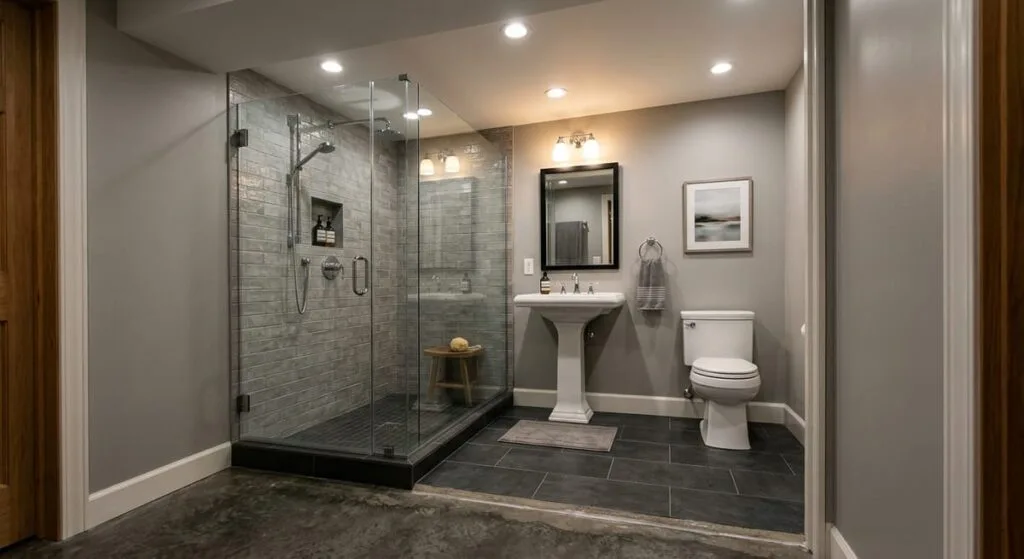
Finishing basement bathroom cost varies significantly with tile selection. Basic ceramic runs $3–$7/sq ft installed; large-format porcelain or stone runs $12–$25/sq ft. Shower walls require cement board backer, standard drywall behind tile is a code violation and a future mold problem.
Basement Bathroom Permit Cost by County
| Jurisdiction | Typical Combined Fees |
|---|---|
| Cherokee County (Woodstock, Canton, Holly Springs) | $150 – $400 |
| Cobb County (Kennesaw, Marietta, Acworth) | $200 – $450 |
| Fulton County (Roswell, Alpharetta, Milton) | $250 – $600 |
Artistic Construction pulls all permits on the homeowner’s behalf in every county we serve. Unpermitted basement bathroom additions create serious disclosure obligations at resale and can void homeowner’s insurance coverage.
See finished basement bathrooms in our basement remodeling portfolio.
Is Adding a Basement Bathroom Worth the Investment?
Adding a bathroom to a home with fewer bathrooms than market standard can recover 60–80% of project cost at resale and reduce days on market. In competitive markets like Roswell and Alpharetta, an additional bathroom drives faster offers. In Woodstock and Canton, a full bath makes a stronger resale case than a half bath.
A $15,000 basement bathroom remodel doesn’t have to come out of pocket. A HELOC at current Georgia rates converts that project into roughly $280–$320/month over five years. Our basement financing guide for Georgia compares current rates from Georgia credit unions and walks through options specific to this market.
If you’re considering bathroom projects beyond the basement, our bathroom remodeling covers above-grade projects and finish options that pair well with a basement addition.
Ready to find out exactly what your basement bathroom will cost? Artistic Construction offers free, no-pressure estimates across Woodstock, Canton, Acworth, Kennesaw, Marietta, Roswell, Alpharetta, Milton, Holly Springs, and Ball Ground. Request your free estimate online, we respond within one business day.
Frequently Asked Questions
How much does a basement bathroom cost in Atlanta?
Most North Atlanta homeowners pay $3,000–$25,000 for basement bathroom installation, with luxury finishes exceeding $40,000. A basement half bath cost runs $3,000–$8,000. A three-quarter bath runs $8,000–$15,000. A full basement bathroom ranges from $10,000–$25,000+. Existing plumbing, slab condition, and finish level are the primary cost drivers.
Do I need to break concrete to add a basement bathroom?
Not always. If your basement has rough-in plumbing stubbed in, concrete cutting isn’t required. Without rough-in, cutting adds $2,000–$6,000. A finished slab makes an upflush system a smarter alternative at $4,000–$9,000 installed, with no concrete work required.
Do I need a permit to add a basement bathroom in Cherokee or Cobb County?
Yes. Basement bathroom permit cost runs $150–$400 in Cherokee County, $200–$450 in Cobb County, and $250–$600 in Fulton County municipalities with 2–4 week review timelines. Skipping permits creates resale disclosure obligations and can void homeowner’s insurance. Artistic Construction handles all permit applications on your behalf.
How long does it take to add a basement bathroom?
A basic half bath with existing rough-in takes two to three weeks. A three-quarter or full basement bathroom without existing plumbing, including concrete cutting, rough-in, framing, tile, and fixtures, runs four to six weeks. Permit review adds one to four weeks depending on jurisdiction.
Can I add a basement bathroom if my home is on a septic system?
Yes, but your septic system must have sufficient capacity for the added fixture load. In Cherokee County, where septic is common in rural Canton, Ball Ground, and Holly Springs, a septic assessment is required before permits are issued. Adding a bathroom to an undersized system without evaluation can result in permit denial or costly system upgrades that significantly increase your total basement bathroom addition cost.



Planning a project?
Skip the guesswork, get real numbers.
Reading is great. A clear, itemized estimate is better. Tell us what you have in mind.