 Est. 2003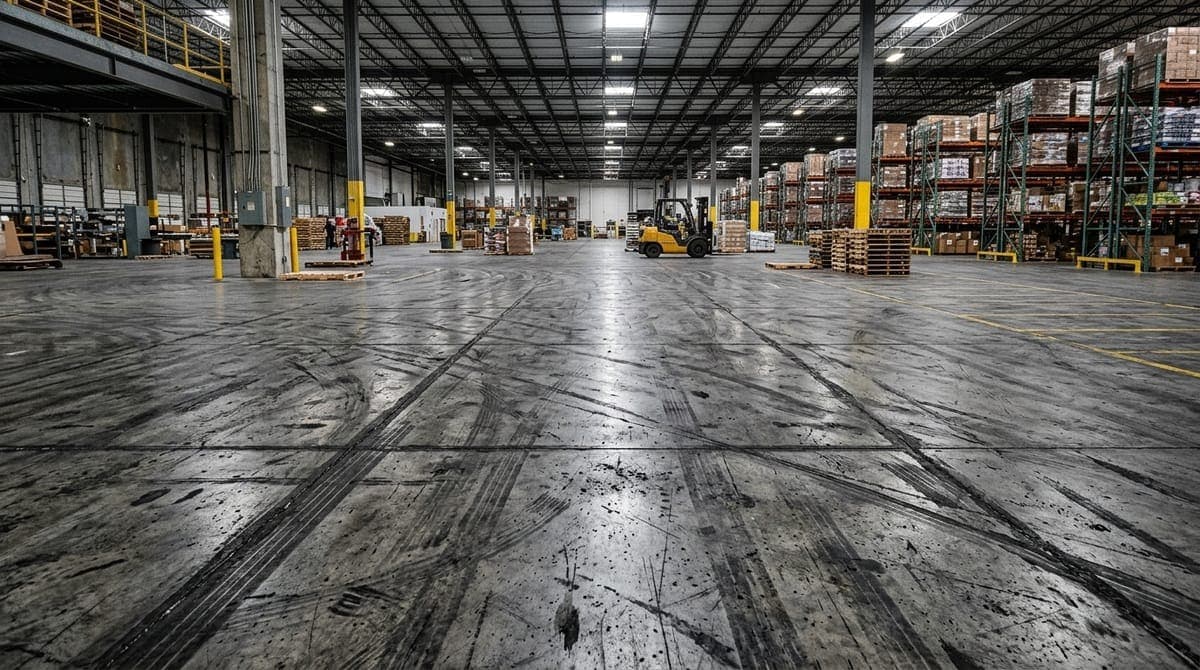
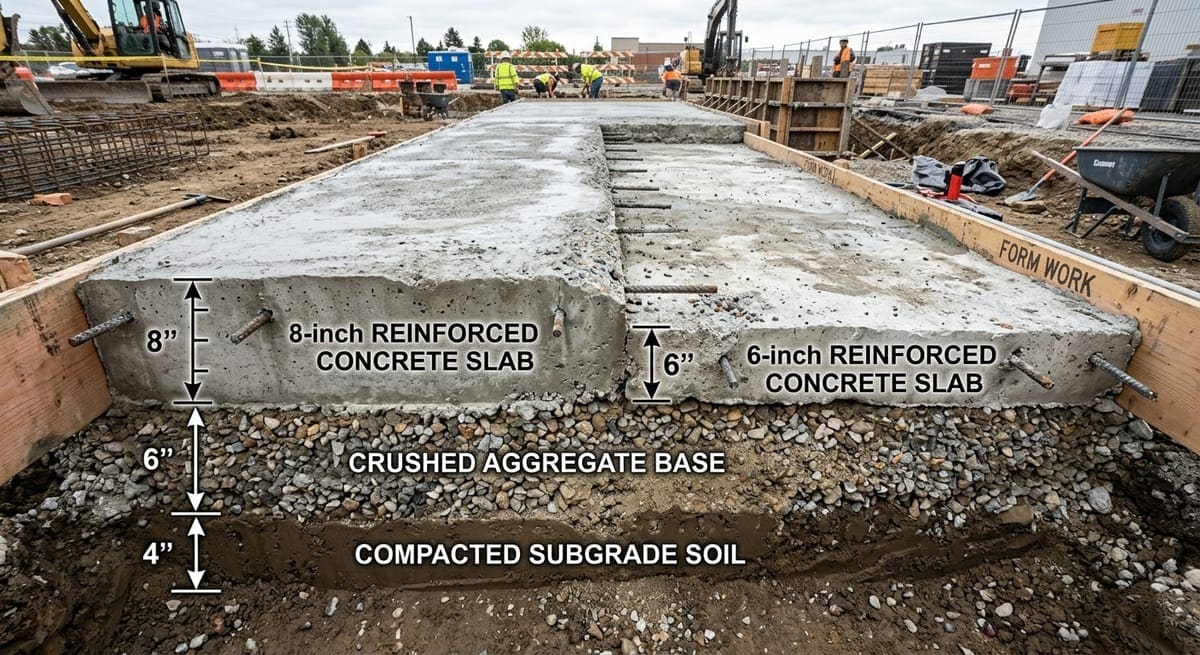
Minimum concrete slab thickness for heavy equipment starts at 6 inches for light industrial use. Real-world applications require 8 to 12 inches depending on forklift capacity, traffic frequency, and soil conditions. Underspecifying thickness creates cracking, spalling, and structural failure requiring costly replacement.
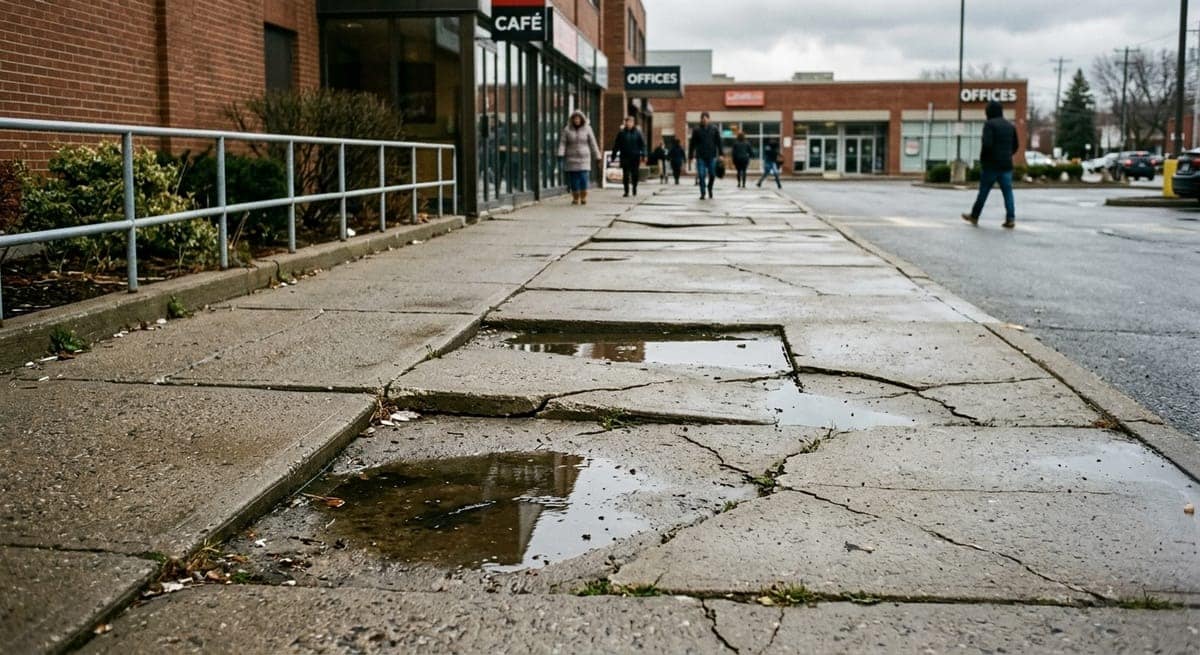
When you’re planning concrete flooring for warehouses, manufacturing facilities, or equipment storage buildings, residential standards don’t apply. Your slab must handle concentrated point loads from forklift tires, repeated traffic patterns, and the specific equipment you operate daily. Underspecifying creates cracking under point loads, surface spalling, joint deterioration, and complete structural failure requiring replacement at 10–15 times the cost of proper initial construction.
Industrial slab thickness requirements by application
| Application | Min. thickness | Typical equipment | Reinforcement |
|---|---|---|---|
| Light industrial & assembly | 6 inches | Forklifts <8,000 lbs, assembly equipment | #4 rebar at 18″ or 6×6 W2.9 mesh |
| Warehouse & distribution | 8 inches | Sit-down forklifts to 15,000 lbs, racking | #5 rebar at 12″, joints ≤15 ft |
| Heavy manufacturing | 10–12 inches | Reach stackers, cranes, presses | Engineered, possible post-tensioning |
| Semi-truck traffic | 12+ inches | Tractor-trailers, container handlers | Structural engineering, custom mix |
North Georgia’s expansive clay soil frequently pushes actual requirements 1–2 inches above theoretical minimums due to upward pressure from soil movement that static load calculations don’t account for.
How to determine correct thickness for your equipment
Equipment load analysis: point loads differ fundamentally from distributed loads. A 5,000-lb sit-down forklift places ~70% of loaded weight on the front axle, roughly 8,000–9,000 lbs across 12 square inches of contact, creating 750 PSI ground pressure. Proper thickness distributes loads to the subgrade while managing repeated cycles and dynamic forces.
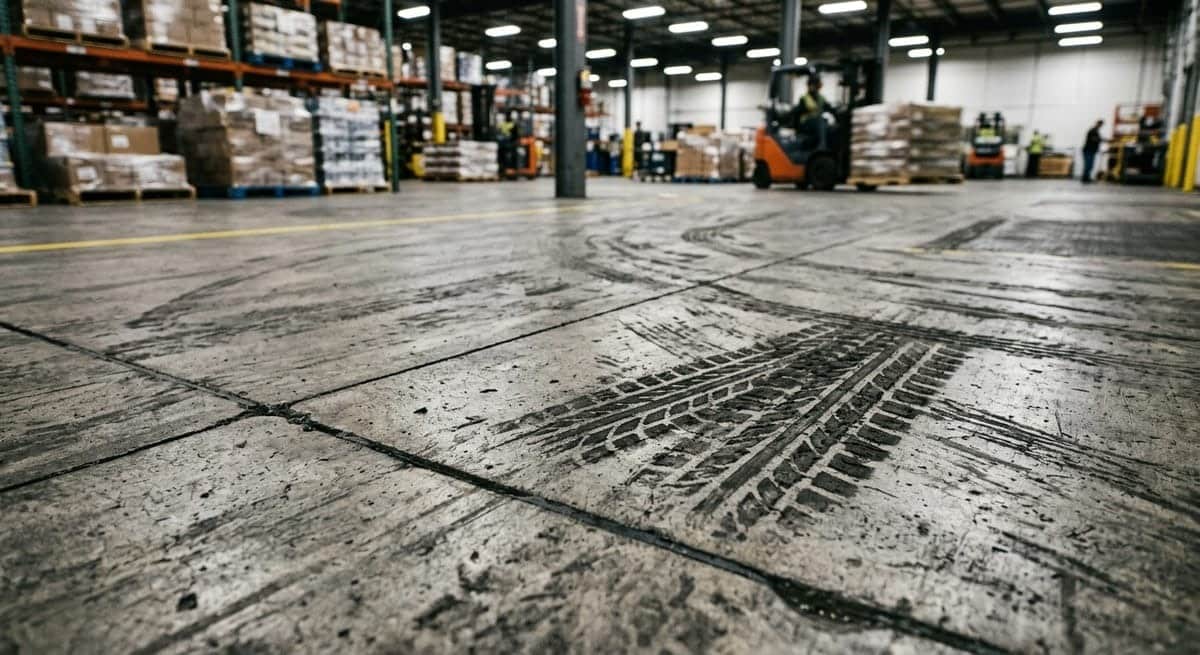
Traffic intensity: joint crossing is the highest-stress event, every loaded forklift crossing a joint creates impact loading exceeding static weight by 30–60%. High-traffic aisles can see 200–500+ crossings per day at specific joints.
Georgia clay soil: red clay shrinks in dry summers and swells in spring, creating cyclical heaving. Heavy-equipment slabs here need 8–12 inches of compacted Class II aggregate base versus 4–6 inches on stable soil. Standard clay provides 2,000–3,000 PSF bearing; compacted structural fill improves it to 4,000+ PSF.
Rebar reinforcement
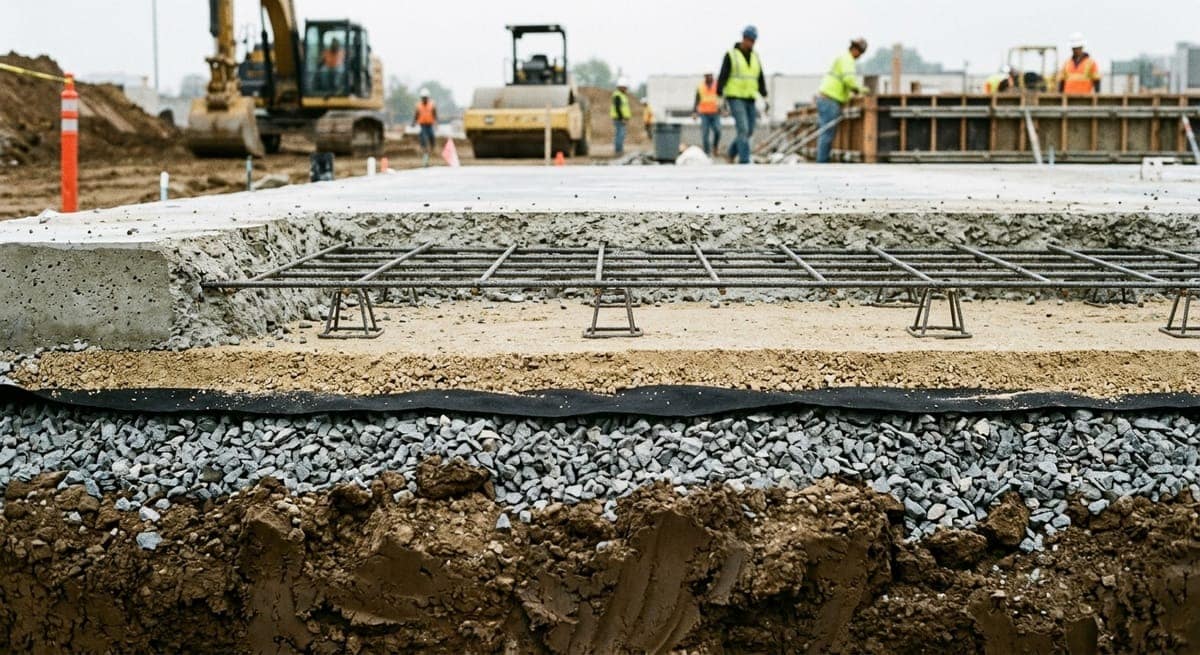
Thickness and reinforcement work together, an 8-inch slab with inadequate reinforcement performs worse than a properly reinforced 6-inch slab. Standard industrial reinforcement uses #4 or #5 rebar at mid-depth in both directions, 12″ on center for heavy-duty, 18″ for lighter use. Post-tensioned slabs allow larger joint-free areas and can reduce thickness 1–2 inches.
ACI standards and design requirements
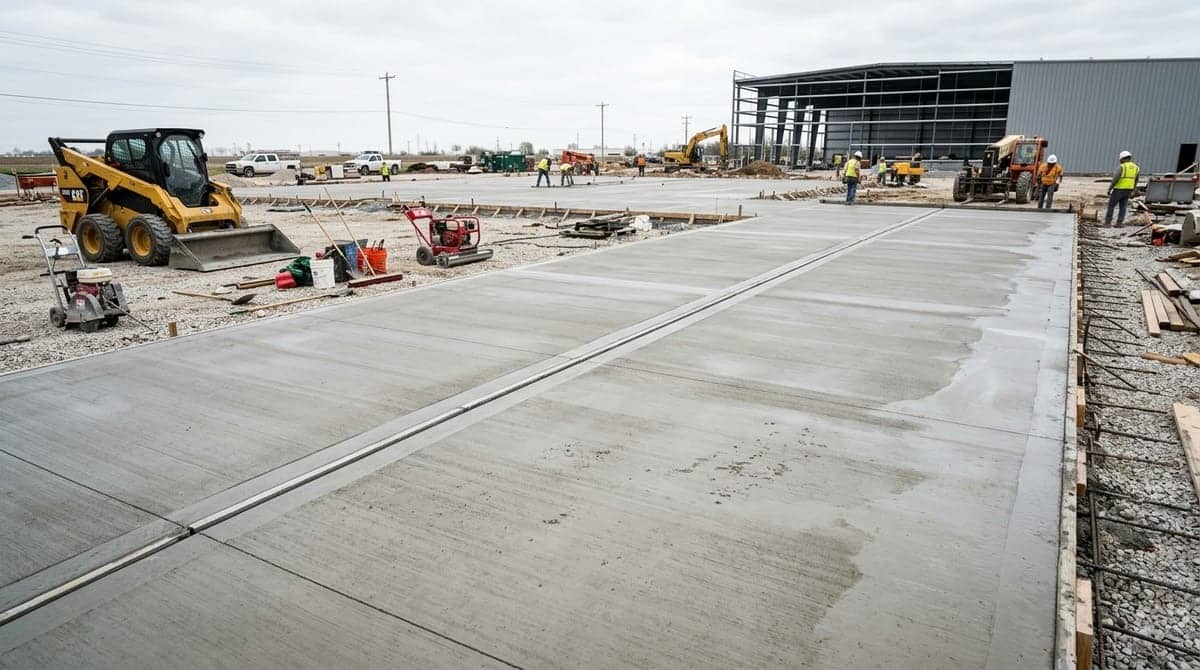
Industrial floor design follows ACI 360. Thick slabs act as rigid pavements: an 8-inch slab spreads a point load across 3–4 feet of subgrade; a 6-inch slab across 2.5–3 feet. Georgia clay tests at k-values of 100–200 PCI undisturbed, rising to 200–300 PCI with proper base. Control-joint spacing decreases as thickness increases, an 8-inch slab needs joints at 12–15 feet. Forklift traffic demands positive load transfer via dowel bars (3/4″ or 1″ smooth steel, 18″ long, 12″ on center).
Industrial mixes require 4,000 PSI minimum (4,500–5,000 for heavy-duty) with a maximum 0.45 water-cement ratio. Flatness: standard warehouse FF25/FL20, narrow-aisle FF35/FL25, high-bay VNA FF45/FL30.
Forklift classifications and thickness
| Forklift class | Capacity | Min. thickness | Application |
|---|---|---|---|
| Class I & II Electric | 3,000–6,000 lbs | 6 inches | Standard warehouse, cushion/pneumatic tires |
| Class IV & V IC | 5,000–15,000 lbs | 8 inches | Sit-down IC units, pneumatic tires |
| Reach/narrow-aisle | Varies | 8 inches | Extended mast, high-bay storage |
| Heavy-capacity | 15,000+ lbs | 10 inches | Large-capacity units, outdoor ops |
CNC machines need 8–10 inches for vibration isolation; stamping presses need 10–12 inches with isolation systems; overhead crane columns require 12–18 inches at column locations. Semi-truck traffic requires 12+ inches based on actual axle loads, not legal highway limits.
Construction best practices
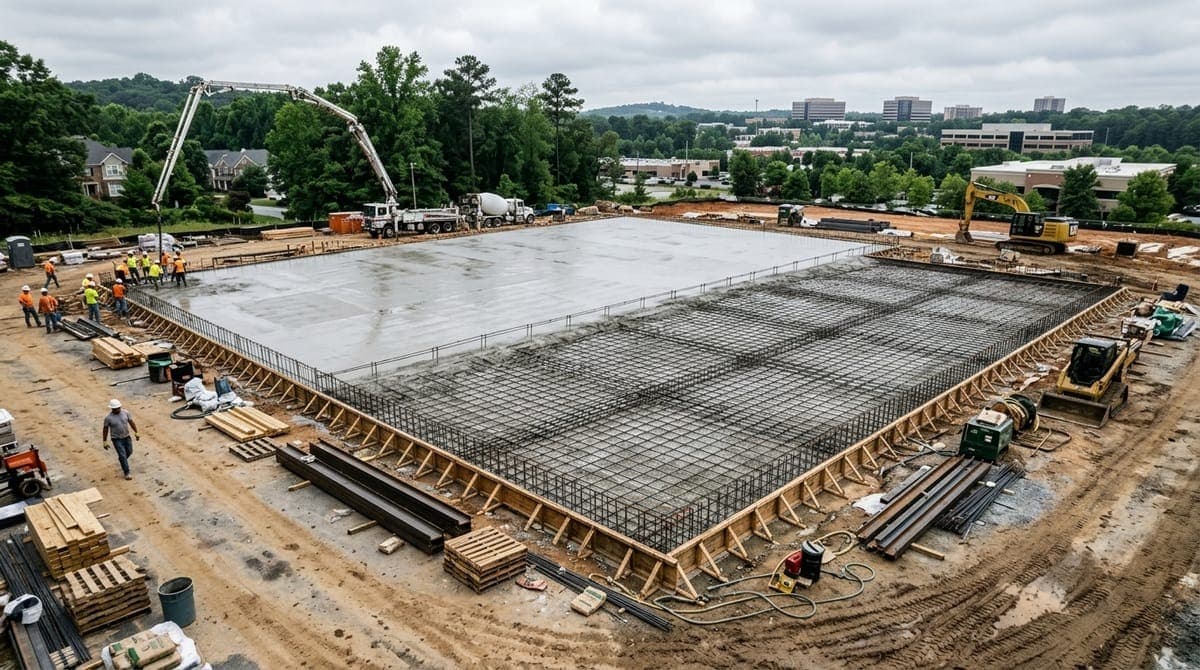
- ✓ Subgrade prep: remove all topsoil/organic material (excavate 12–18 inches), install geotextile fabric, place Class II base in 6-inch lifts to 95% Standard Proctor density
- ✓ Vapor barrier: 10-mil poly or 15-mil cross-laminated retarder, seams overlapped 6 inches and sealed
- ✓ Reinforcement placement: rebar at mid-depth on rated chairs
- ✓ Placement & finishing: 4–5″ slump, laser-guided screed and riding trowels for FF/FL targets
- ✓ Curing & joints: ASTM C309 curing compound; cut control joints within 6–12 hours at 1/4–1/3 slab depth; wait 7–28 days before heavy traffic
Cost & life-cycle value
Moving from 6-inch to 8-inch thickness adds ~33% concrete volume plus modest labor, but prevents future expenses far exceeding the savings. An adequately specified 8-inch slab lasts 35+ years with minimal maintenance; a marginal 6-inch slab may need major repair in 10–15 years with business disruption. The “cheaper” option costs substantially more over typical ownership. Contact our commercial concrete team for a project evaluation.
Frequently asked questions
What is the minimum thickness for garage floors with vehicle traffic?
Residential garage slabs require 4 inches for standard passenger vehicles. For RVs, boats on trailers, or work trucks, specify 5–6 inches with proper reinforcement.
Can I use different thicknesses throughout my facility?
Yes. Design lighter-traffic areas at 6 inches while specifying 8–10 inches in forklift aisles and heavy equipment zones.
How do I verify my contractor is installing the specified thickness?
Require depth verification at a minimum of 10 locations per 5,000 square feet using depth gauges or steel probes before concrete sets, documented with photos.
How soon can I allow forklift traffic on a new slab?
Wait a minimum of 7 days (about 70% strength). Start with light equipment and limited traffic, increasing to full operations over 14 days.
Planning a project?
Skip the guesswork, get real numbers.
Reading is great. A clear, itemized estimate is better. Tell us what you have in mind.